

Photo source: Mazalweddings.ro
A beach wedding in Greece sounds like a dream – golden sunsets, turquoise waters, soft sand beneath your feet, and a celebration that feels both intimate and spectacular. But once the excitement settles, one very practical question follows: how much does it actually cost?
As we look toward 2026, this question becomes even more relevant. Demand for destination weddings in Greece remains strong, particularly during peak season months, and early planning is increasingly important to secure preferred dates and private beachfront venues.
The answer isn’t as simple as a single number. A beach wedding in Greece can range from a beautifully curated intimate gathering to a fully customized, high-end celebration by the sea. The final investment depends on location, guest count, decor concept, catering style, legal requirements, and most importantly the level of planning and coordination involved.
For couples planning from abroad and for wedding planners organizing destination events, understanding the real cost structure is essential. Greece offers incredible value compared to many Western European destinations, yet pricing varies significantly depending on whether you choose a public beach, a luxury resort, or an exclusive private venue.
This is where working with a trusted local partner becomes crucial. For international couples and planners seeking a seamless experience, a Greece-based, full-service company like Mazal Weddings bridges the gap between vision and execution. Operating worldwide and delivering weddings locally in Greece, Mazal Weddings combine on-the-ground expertise with tailored planning – managing everything from legal paperwork and venue logistics to design, guest experience, and reception coordination.
In the following sections, we’ll break down what factors influence the budget, and how choosing the right local team can make the difference between a complicated process and a truly effortless celebration by the sea.
Table of Contents
What Influences the Cost of a Beach Wedding in Greece?
There is no standard price for a beach wedding in Greece because each event is built around specific structural choices. The final cost is determined by how the celebration is designed, coordinated, and executed.
Below are the key elements that directly shape the overall investment.
Guest Count and Event Scale
The number of guests affects nearly every operational component of the wedding. Catering quantities, seating arrangements, table settings, staffing levels, sound coverage, and venue capacity all scale according to attendance.
Smaller gatherings tend to involve simplified logistics and lighter production requirements. Larger celebrations require expanded coordination, additional equipment, increased staffing, and more complex layout planning.
As guest count increases, so does the level of organizational structure needed to maintain flow and guest experience.
Ceremony and Reception Structure
Whether the event consists of a simple ceremony followed by a private dinner or a full-scale reception with entertainment significantly influences cost.
A wedding that includes a complete reception typically involves:
- Catering service
- Beverage management
- Sound and lighting systems
- Entertainment professionals
- Coordinated timeline management
The depth of the reception program directly affects vendor involvement and production complexity.
Catering and Service Model
Catering is one of the most substantial structural components of a beach wedding in Greece. The format selected influences staffing, equipment, and preparation requirements.
Factors that affect catering-related costs include:
- Number of courses
- Menu customization
- Beverage package structure
- Duration of service
Venue Type and Location
The choice between a public beach and a private beachfront venue significantly shapes both logistics and budget structure.
Public beaches may require municipal permits, impose sound limitations, and restrict setup times. They do not guarantee privacy and often require separate arrangements for the reception.
Private beach venues operate in controlled environments. They provide exclusive use of the space, defined infrastructure, and the possibility of hosting both ceremony and reception in one location. This consolidation can reduce transportation needs and simplify production coordination.
Venue exclusivity, accessibility, and infrastructure availability all influence the final financial structure.
Legal Framework: Civil vs Symbolic Ceremonies
The type of ceremony selected also influences administrative obligations.
Civil weddings in Greece require:
- Legal documentation
- Certified translations
- Apostille certification
- Coordination with local municipal authorities
These procedures involve processing time and administrative oversight.
Symbolic ceremonies remove legal documentation requirements and offer greater flexibility in scheduling and location choice.
What Determines the Final Budget?
The final number depends on:
- Guest count
- Catering style
- Venue exclusivity
- Design complexity
- Entertainment level
- Legal requirements
- Planning structure (partial vs. full-service)
For international couples and wedding planners working worldwide, collaborating with a Greece-based team such as Mazal Weddings means entrusting the entire celebration to a single, coordinated structure. From civil or religious ceremonies to venue management, music, catering, décor, and on-site execution, every component is professionally organized within one integrated planning framework.
With comprehensive planning support in place, couples are free to focus on the experience itself. Instead of managing vendors and timelines, they can simply enjoy their wedding day and the time shared with family and friends, knowing that every detail has been carefully handled.
Why a Private Beach Venue Can Be More Efficient for Couples
Choosing between a public beach and a private beachfront venue is not simply a question of price. A private venue is not necessarily less expensive, but the real advantage lies in efficiency, control, and cohesion.
Public beaches often require municipal permits, sound approvals, and strict time restrictions. They may also require hosting the ceremony and reception in separate locations, which adds transportation logistics, multiple setups, and increased coordination.
A private beachfront venue typically allows both ceremony and reception to take place in one exclusive setting. Vendors install once, guests remain in one location, and the timeline flows more naturally. Built-in infrastructure such as power supply and reception facilities further simplifies production.
The result is not automatically a lower overall investment, but a more structured and predictable event.
When a private venue is combined with full planning support, such as the services offered by Mazal Weddings, couples benefit from centralized coordination of logistics, décor, music, catering, and guest management. One dedicated team oversees the entire celebration, reducing fragmentation and improving clarity.
The difference is not about cheaper versus more expensive. It is about creating a streamlined, well-managed destination wedding experience.
Key Factors That Influence the Cost of a Beach Wedding in Greece
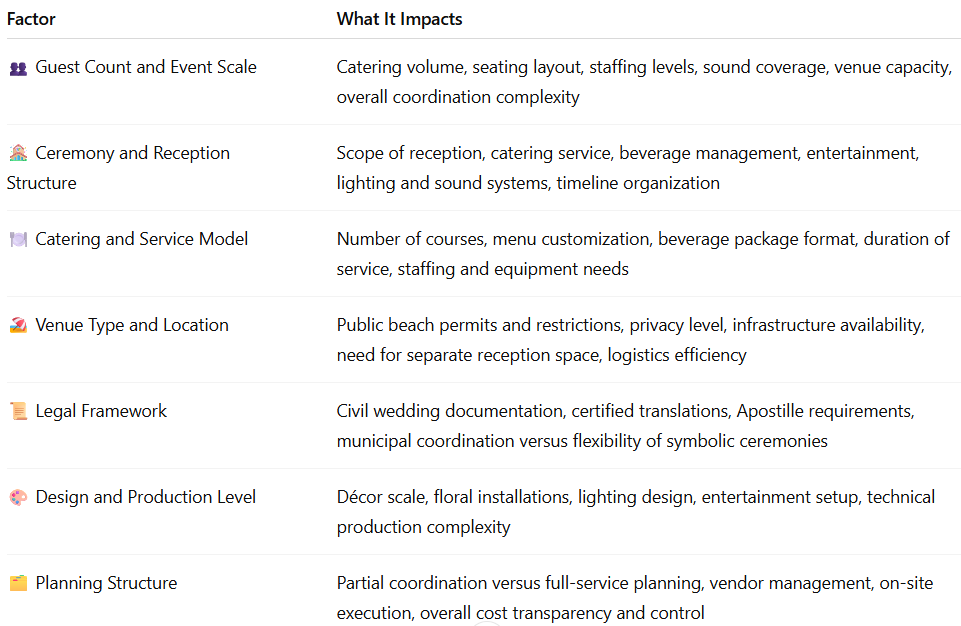
Final Thoughts: Budget with Clarity, Plan with Structure in 2026
So, how much does a beach wedding in Greece cost in 2026?
There is no single fixed answer, and that is precisely the point. A beach wedding is not a standard product with a flat rate. It is a structured event shaped by location, guest count, catering format, legal requirements, design vision, seasonality, and production scale. In 2026, with continued demand for destination celebrations and strong peak-season booking patterns, early financial clarity is more important than ever.
The final investment depends on how these elements are combined.
When costs are approached separately – venue in one place, reception in another, multiple vendors operating independently – the budget can quickly become fragmented. Administrative fees, transportation logistics, infrastructure rentals, and coordination layers add complexity.
When the celebration is structured around one cohesive operational model, financial clarity improves.
Hosting both the ceremony and reception in a fully private beachfront setting eliminates duplication of logistics. Working with a professional team that manages planning, vendor coordination, documentation guidance, and on-site execution reduces hidden variables. The integrated approach reflected in the services offered by Mazal Weddings – combining an exclusive private venue in Greece with comprehensive planning support – allows couples and international wedding planners to centralize production and build a realistic, transparent budget framework from the beginning.
A beach wedding in Greece is not defined by a single price point. It is defined by how efficiently the experience is designed and executed.
Clear budgeting does not mean limiting vision. It means aligning expectations, structure, and expertise to create a seamless celebration by the sea.
Frequently Asked Questions About Beach Weddings in Greece
What factors influence the cost of a beach wedding in Greece the most?
The overall investment is primarily shaped by guest count, venue type, catering structure, ceremony format, and the level of design and production involved. Legal documentation for civil weddings, seasonality, and entertainment choices also play an important role. The way these elements are structured together has a direct impact on cost predictability.
Is it better to choose a public beach or a private venue?
The decision depends on priorities. Public beaches may involve municipal permits and logistical restrictions, including sound limitations and setup windows. Private venues offer controlled access, full privacy, and the possibility of hosting both ceremony and reception in one location. This often simplifies coordination and reduces operational complexity.
Do international couples need special documentation to marry in Greece?
Yes. Civil weddings require official documentation, certified translations, Apostille certification, and coordination with the local municipality. Requirements may vary depending on nationality. Symbolic ceremonies, by contrast, do not require legal paperwork and offer greater flexibility.
How does guest count affect the overall structure of the wedding?
Guest count influences nearly every logistical component of the event. Catering volume, seating layout, venue capacity, sound system requirements, and staffing levels all scale according to the number of attendees. Larger guest lists also increase coordination complexity, which may require expanded planning and production support.
Why is working with a local planning team important?
Destination weddings involve coordination across venues, vendors, legal authorities, and guest logistics. A Greece-based planning team provides on-the-ground oversight, manages communication with local suppliers, and ensures compliance with regional requirements. This centralized approach improves clarity, reduces unexpected complications, and supports a smoother execution process.